
Repositorio Digital
Por favor, use este identificador para citar o enlazar este ítem:
http://repositorio.cedes.org/handle/123456789/4467| Título : | Regulatory initiatives to reduce sugar-sweetened beverages (SSBs) in Latin America | Autor : | Mejía, Raúl M Castagnari, Valentina Bergallo, Paola Fernández, Alicia |
Palabras clave : | Salud publica;Azúcares de la Dieta | Fecha de publicación : | 2018 | Editorial : | 1932-6203 | Resumen : | BACKGROUND AND OBJECTIVES: Latin American (LA) countries have begun to adopt a variety of regulations targeting sugar-sweetened beverages (SSBs) for public health reasons. Our objective was to characterize the regulatory strategies designed to reduce SSB consumption over the last decade, and assess the available evidence on their enforcement and impact. METHODS: We searched legal and public health databases for public and private SSBs regulations in 14 LA countries and then conducted a systematic review of the available literature. We tracked comparative variations in the type of body issuing the regulations, their scope, and binding status. We present data following a 5-category framework we named NUTRE that classifies SSBs regulations as: (1) restrictions to SSB availability in schools (N), (2) taxes and other economic incentives to discourage consumption (U), (3) restrictions on advertising and marketing (T), (4) regulations on government procurement and subsidies (R), and (5) product labeling rules (E). RESULTS: Since 2006, 14 LA countries have adopted at least 39 public and private SSB regulatory initiatives across the NUTRE framework. Comprehensive efforts have only been approved by Chile, Mexico and Ecuador, while the rest have comparatively few initiatives. 28 out of the 39 regulatory initiatives were passed by legislative and executive bodies; 11 initiatives represent self-regulatory undertakings by the beverage industries. An 86% (24/28) of public sector regulations are binding; 56% (22/39) contain explicit monitoring or evaluation methods; and 62% (24/39) provide for sanctions. Moreover, 23 regulations specify the body in charge of monitoring the new rules and standards. CONCLUSIONS: LA countries are targeting SSB consumption through a variety of mechanisms, particularly via restrictions to availability in schools and through taxes. Interdisciplinary evidence comparing alternative regulatory strategies is scarce, and few studies offer data on impact and implementation challenges. More evidence and further comparative assessments are needed to support future decision-making. | URI : | http://repositorio.cedes.org/handle/123456789/4467 | DOI: | 1932-6203 10 e0205694 13 10.1371/journal.pone.0205694 |
| Aparece en las colecciones: | Artículos en publicaciones periódicas |
Ficheros en este ítem:
| Fichero | Descripción | Tamaño | Formato | |
|---|---|---|---|---|
| journal.pone.0205694.pdf | Artículo en inglés | 656,58 kB | Adobe PDF | 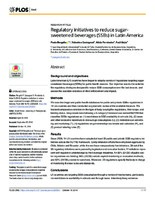 Visualizar/Abrir |
Visitas de página(s)
292
comprobado en 08-ago-2026
Descarga(s)
88
comprobado en 08-ago-2026

Google ScholarTM
Consultar
Altmetric
Los ítems de DSpace están protegidos por copyright, con todos los derechos reservados, a menos que se indique lo contrario.